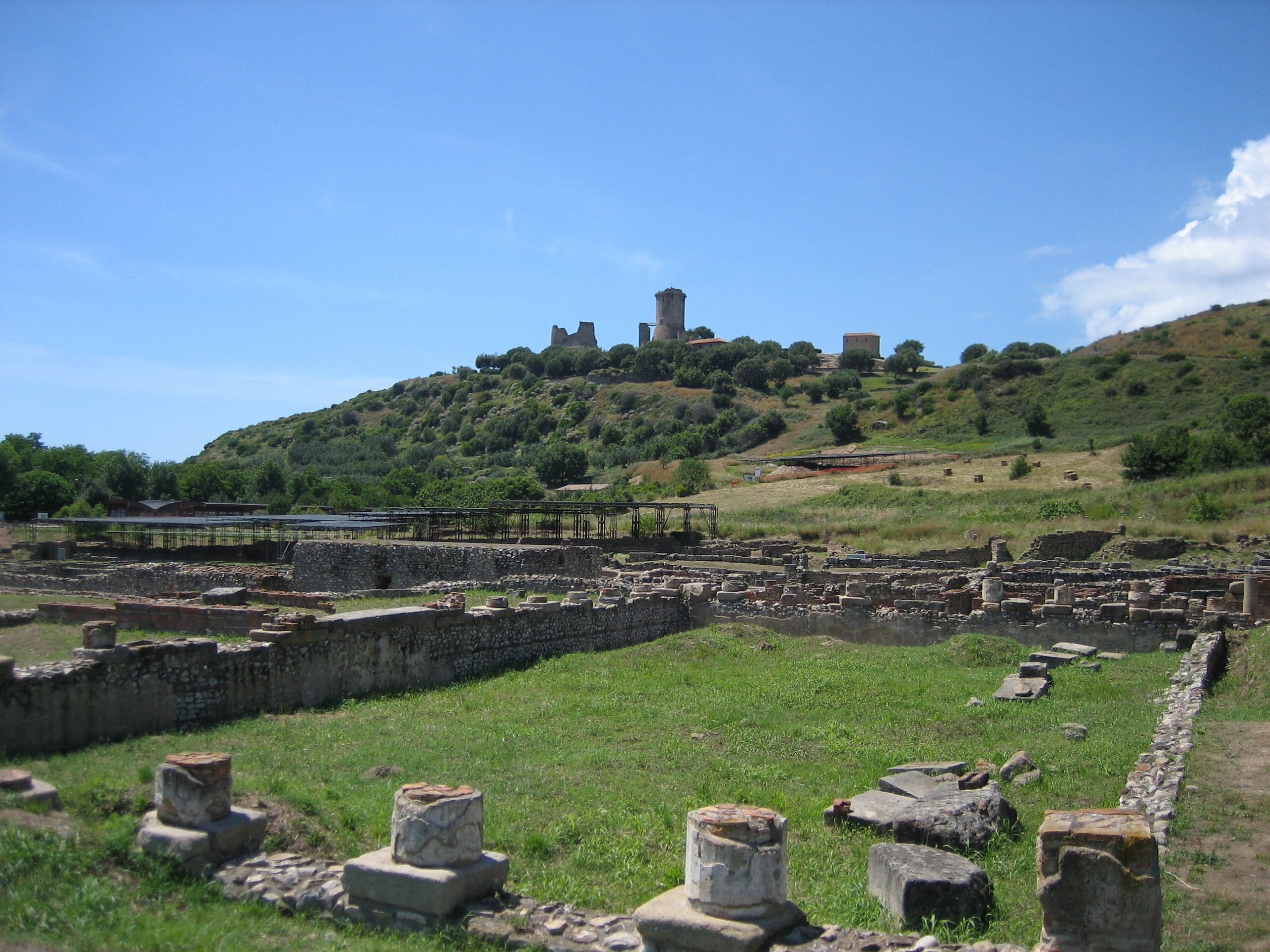
The founders of Elea-Velia came from Phocaea, a coastal town in present-day Turkey, north of the city of Smyrna. The Phoceans were traders, explorers and pirates. Some scholars have called them the 'Vikings of antiquity', the most intrepid adventurers in Greece, who went beyond the Strait of Gibraltar, which the ancients considered to be the boundary of the known world. Through their travels they turned into reality what for others was only a dream. Herodotus, defined by the ancient Greeks as the 'father of lies', tells us about the foundation of Elea-Velia through real facts and legends. Around 550 BC, Phocaea was coming under pressure from the Persian Empire, which was interested in subjugating the Greek cities on the Turkish coast of the Aegean Sea. Unlike the other Greek colonies in the area, such as Ephesus and Miletus, the Phocaeans decided to leave the motherland. The Phocaeans piled up everything they could and loaded it onto their ships together with their families. They took with them images, sacred objects and everything else they could carry. After the refusal of the inhabitants of Chios to buy some of the islets scattered along the coast of Asia, the exiles were forced to return to the sea. But they made an oath: they threw a block of iron into the sea and swore that no one would return to Phocaea until the iron surfaced. This meant that they would never return. They decided to head west towards Corsica. Twenty years earlier some Phocaeans had left the motherland and settled on that island where they founded Alalia. In those days, founding a colony was a challenging task, and in order to choose a place it was necessary to consult the oracle of the god Apollo at Delphi. Apollo usually gave answers through riddles. After the consultation, the Phoenicians interpreted the words of the oracle and realised that they had to build a new homeland in 'Kyrnos', the Greek name for Corsica. The mass arrival of the Phoenicians in Alalia alarmed the Etruscans and the Carthaginians. The latter joined forces and waged war on Alalia, inflicting heavy losses on the Phocean people. The newcomers found themselves once again without a homeland, they returned to the sea, but this time their discomfort was even greater. Although they had followed the indications of the oracle, their fate was becoming increasingly uncertain. But when they reached Reggio Calabria they met the man who changed their destiny. A stranger from Posidonia, the Greek name for Paestum, clarified their doubts. The stranger said: 'You weremistaken, you thought Apollo told you to build a dwelling in Cirno, but you misunderstood his words. What he meant was to build a dwelling for Cirno". Quite simply, Cirno was both the Greek name for Corsica and the name of a mythical hero, son of the most important hero, Heracles or Hercules. But who was this stranger who suddenly appears and frees the tormenting doubts that gripped the poor exiles from Corsica in search of a place to settle. It would seem like a character from a fairy tale who eventually arrives and solves everything. In reality, such men did exist in southern Italy in those days. They were a kind of 'wisemen' who could see beyond appearances, who could interpret oracles, dreams and the enigmas of existence. They were known as 'Pythagoreans' because they lived according to the teachings of Pythagoras. The Phocaeans followed the advice of the stranger and built their new homeland near Posidonia. Our civilisation owes much to these wise men of antiquity. Different peoples at different times called the city by different names: Yele, Elea, Velia.
The foundation of Elea-Velia between history and legend